
The Kata
Niten is a solely kata focused art – and thus unlike Kendo, is practiced without wearing armour.
Kata can be defined as a set combination of positions and movements, performed as an exercise to build muscle memory and teach the fighting techniques of the school. The word translates as ‘form’ in Japanese.
Kats is often misunderstood as being something that is rigid, and inflexible. This is not the case – instead the goal is for the movements and techniques to be internalised to the point they can be executed and adapted under different circumstances.
When compared to similar arts such as Zen Nippon Kendō Renmei style Iaido (not old school), Niten kata are generally less prescriptive.
We have knowledge of, and can teach the following Niten kata.
1) Tachi Seiho (太刀勢法) Twelve techniques with long sword:
- 指先 Sassen
- 八相左 Hasso Hidari
- 八相右 Hasso Migi
- 受流左 Uke Nagashi Hidari
- 受流右 Uke Nagashi Migi
- 捩構 Moji Gamae
- 張付 Haritsuke
- 流打 Nagashi Uchi
- 虎振 Tora Buri
- 数喜 Kazuki
- 合先打留 Aisen Uchidome
- 余打 (アマシ打)Amashi Uchi
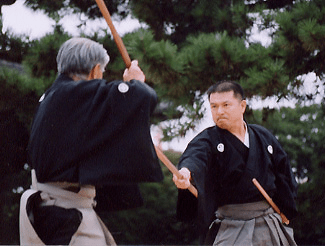
2) Kodachi Seiho (小太刀勢法) Seven techniques with a short sword:
- 指先 Sassen
- 中段 Chudan
- 受流 Uke Nagashi
- 捩構 Moji Gamae
- 張付 Haritsuke
- 流打 Nagashi Uchi
- 合先 Aisen
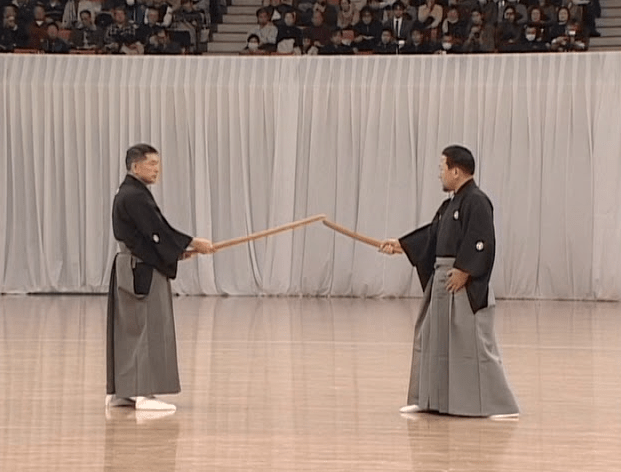
3) Nito Seiho (二刀勢法) Five techniques with two swords corresponding to the five forms in the Water Scroll:
- 中段 Chudan
- 上段 Jodan
- 下段 Gedan
- 左脇構 Hidari Waki Gamae
- 右脇構 Migi Waki Gamae
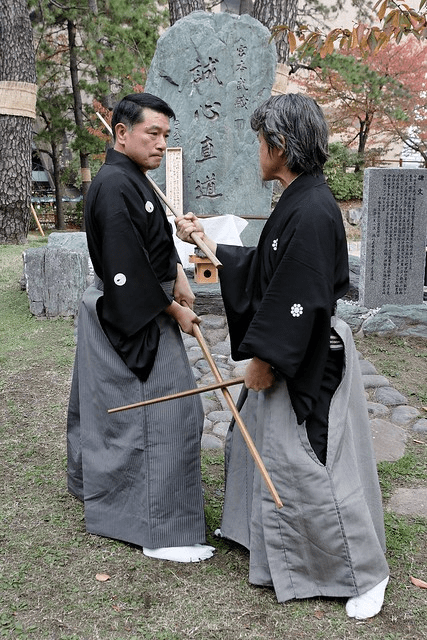
Outside of the above, there also exist the following sets:
Tachi ai Bo Seiho 太刀合棒勢法 (Long staff against sword)
Bo ai Bo Shidai no Koto 棒合棒次第のこと (Long staff against Long staff)
Jittejutsu 十手術 (Truncheon)
Yawara 柔 (Unarmed techniques)
These are yet to be widely transmitted outside of Japan. At this time, we therefore do not teach these as part of our syllabus.
 Newcastle Niten